Bars · Restaurants · Lounges · Venues · Offices
SOUND TESTING & TUNING
IN CHICAGO
A room can be loud and still be hard to hear in. We measure what yours is doing, tune the system speaker by speaker, treat the walls and ceiling where tuning can't reach, then measure again so you can see the difference in numbers.
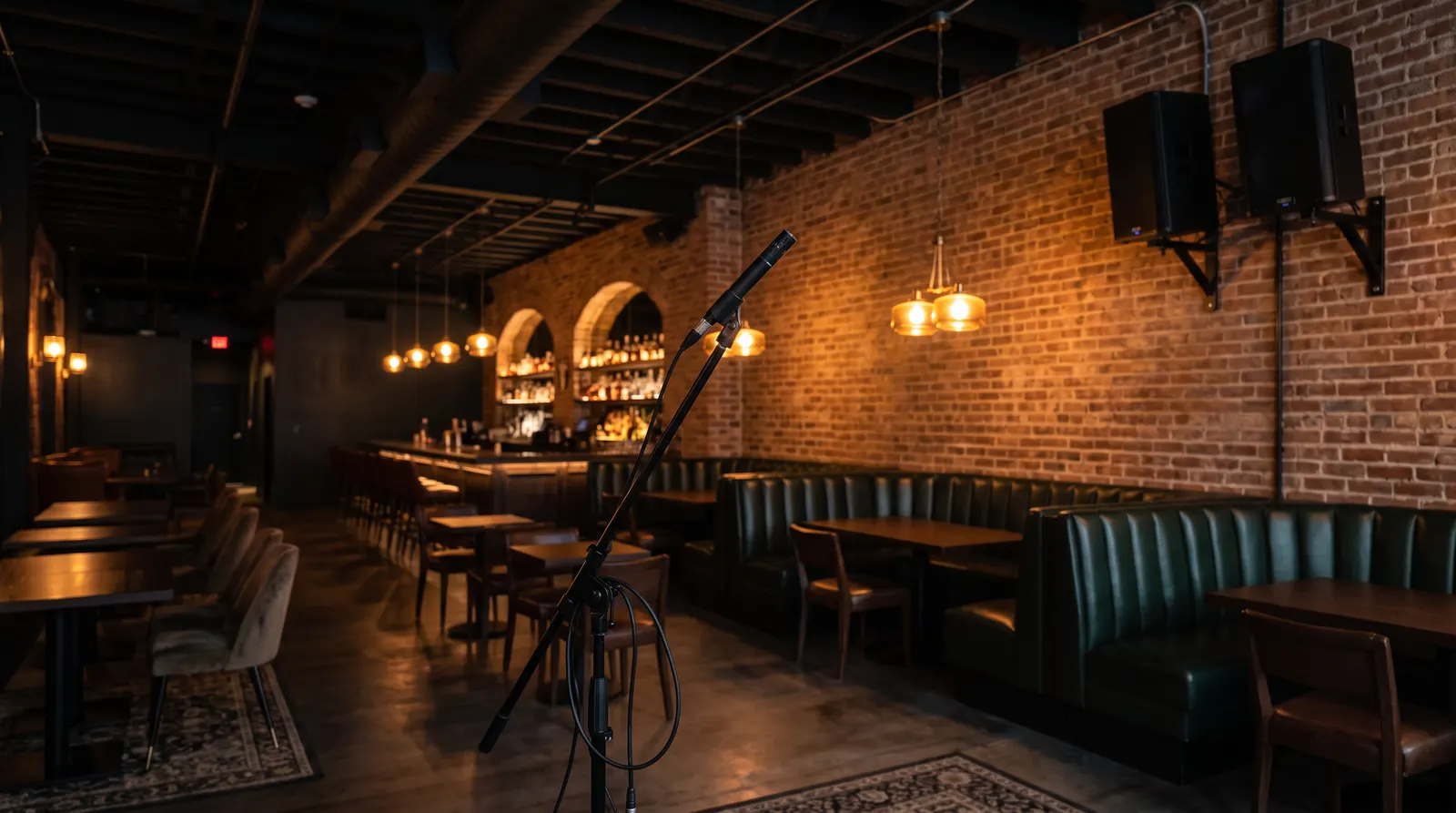
Loud isn't the same as clear

Brick, glass, tile and an open ceiling look good and sound hard. People often say surfaces like that carry the sound. They don't. The speakers carry it, and the walls bounce it back a moment late.
So everyone in the room hears the music once from the speaker, then again and again off every hard surface. Those late copies stack up and smear it. That's the gym effect: you can hear someone across the room and still not make out a word.
It costs you in a few ways. Guests raise their voices to get over it, the next table does the same, and the DJ turns up to get over them. Turning the speakers up doesn't help, because the echo goes up by the same amount. Microphones suffer most, and feedback starts sooner.
A ten-second check: stand in the middle of the empty room and clap once, hard. The ring that follows is sitting on top of your music all night.
What we measure

Reverberation time. How many seconds a sound takes to die away. It's the main number for an echoey room, and it's the one treatment changes.
Each speaker's response. A test signal through one speaker at a time, with a measurement microphone where people sit, shows which frequencies that speaker and that spot are exaggerating.
Loudness at the seats. How loud it really is at the tables, the bar and the booth, so levels are set from readings and not from wherever the person at the mixer happens to stand.
We test with the room empty, mark every microphone position, and note the conditions — doors, HVAC, furniture, volume. That's what makes the second test comparable to the first.
Tuning the system

Every speaker gets its own EQ. We cut the frequencies the room exaggerates. Cutting, not boosting.
The subwoofer gets a crossover. Lows go to the sub and come out of the tops, which cleans up the middle and lets the tops play louder without strain.
Levels are set zone by zone. The speaker over the booths can sit lower than the one over the dance floor.
Limiters cap the top end. They keep a heavy-handed DJ from driving the system as hard as it will go.
Presets are saved. One for DJ night, one for live music, one for a quiet weekday. Your staff recall a preset and don't mix from scratch.
This needs a mixer or processor that can do it. Most digital mixers can; most older analog ones can't. If yours can't, we quote one, set it up, and tell you plainly whether you'd be better served by tablet control or by real faders your staff can put a hand on.
Speakers, mixers and cabling
Tuning can't fix a speaker aimed at a wall, so placement comes first. We aim speakers at people, not at brick.
Mounting. Speakers go on brackets rated for that model, anchored into the structure, each with a safety cable. Never tied off to pipes or conduit, and never hung from a drop-ceiling grid.
Cabling. Balanced lines from the mixer to each speaker, routed away from power and lighting, labeled at both ends, and colored to disappear against the ceiling.
Inputs. A place for the DJ and for performers to plug in at the stage, so nobody is trailing cables across the floor to reach the mixer.
Treating the room
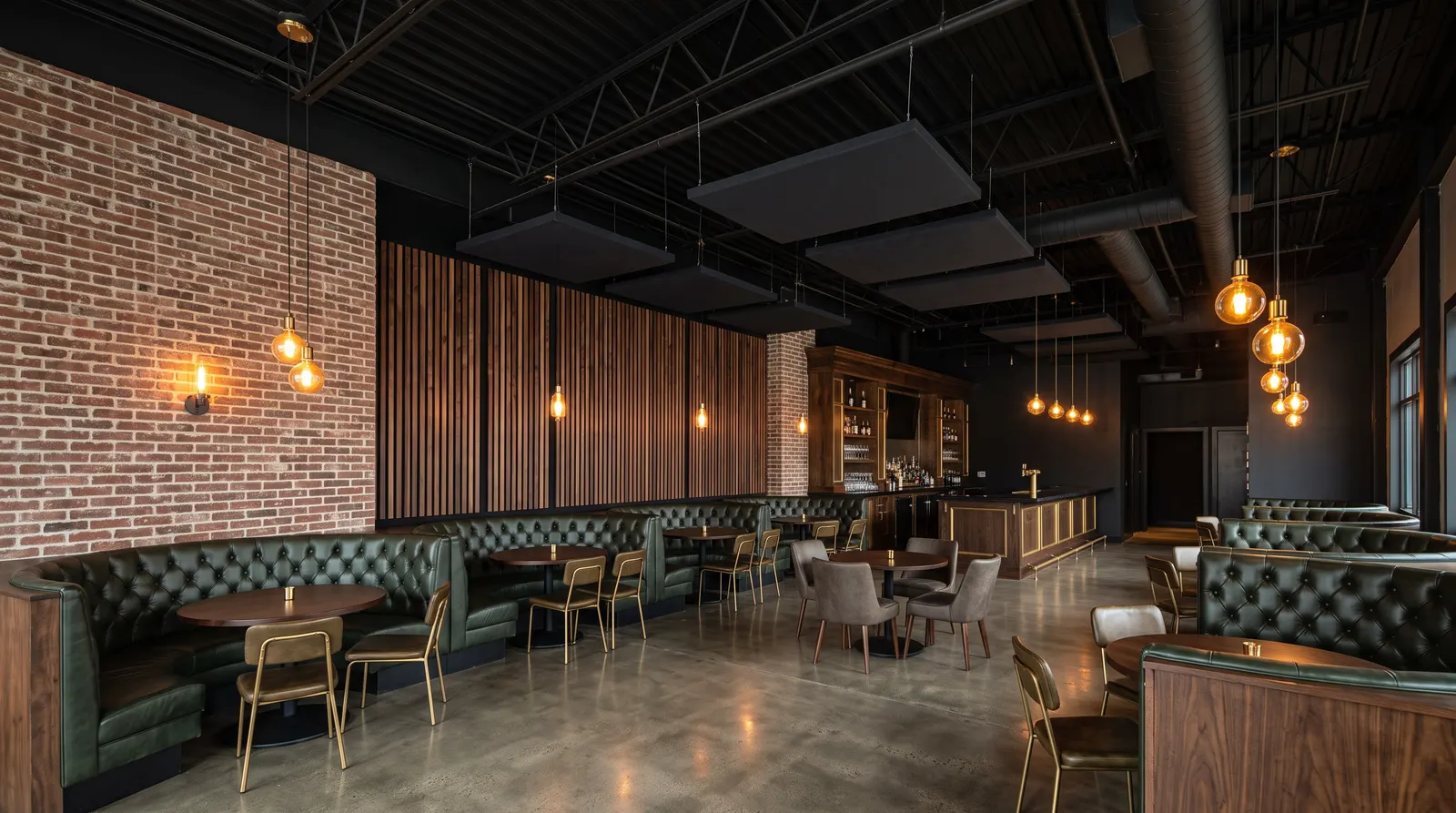
An example of the kind of treatment we hang, not a photo of a finished job of ours.
EQ changes what comes out of the speakers. It can't remove echo. For that, something soft has to replace some of the hard surface, and it doesn't have to look like a recording studio.

Wood slat panels. Timber slats over acoustic felt. Warm against brick, and they read as a design choice.
Printed art panels. Acoustic panels with your artwork, photography or logo printed on the fabric. They look like framed pieces.
Upholstered and felt panels. Padded panels above booths in the same fabric as the seating, or felt tiles laid out as a feature wall.
Ceiling clouds and baffles. Panels hung under an open ceiling. In black against a black ceiling they vanish, and the ceiling is usually the largest untreated surface in the room.
Drop ceiling tiles. If you already have a grid, swapping standard tiles for high-absorption ones is the cheapest fix going. Tiles carry an NRC rating from 0 to 1 for how much sound they absorb, and decorative tin or plastic tiles absorb next to nothing.
Heavy drapes. Over windows or a bare wall, pleated and hung a little off the surface.
Thickness and coverage matter more than the brand. Thin foam only softens the highs, and two panels in a big room won't be heard. We work out how much the room needs from the first measurement, and we don't deaden it — a lounge should still feel alive.
The rules we work to
Fire rating. Wall and ceiling finishes in a commercial space need a fire rating. We only hang products that come with a Class A test report (ASTM E84), and we check that the rating covers the whole panel and not just its backing. Bargain foam usually has no rating at all.
Sprinklers. Nothing gets hung where it blocks a sprinkler head's spray. If a ceiling plan needs heads moved, that's a licensed sprinkler contractor's job, and we'll tell you before you order anything.
Kitchens. Near food prep you generally need washable tiles, which absorb less. The acoustic material goes in the dining room and the bar.
The before-and-after report
When the work is done we repeat the first test exactly: same microphone positions, same speaker, same volume, same room conditions.
You get a short report with both sets of numbers side by side — reverberation time by frequency band, and the response of each speaker before and after tuning.
We don't promise a figure before we've measured. Rooms differ, and anyone who quotes you a result sight unseen is guessing. What we promise is that you'll see what changed.
What this isn't, and what it costs
It isn't soundproofing. Panels and tiles absorb sound inside the room. They don't stop it reaching the neighbors or the unit upstairs. That means building mass into walls and ceilings, which is construction work, and we'll say so if that's your real problem.
It isn't a certified acoustical study. We're installers who measure our own work. If you need a stamped report for a noise complaint, a lease dispute or a permit, you want a licensed acoustical consultant.
It's quoted per job. The number depends on the size of the room, how many speakers, what gear is already there and how much treatment it needs. Testing and tuning an existing system is a much smaller job than treating a ceiling, and you can do them in stages.
Tell us about the room
What the walls and ceiling are, how many speakers, what plugs into them, and what bothers you about the sound. A short video of the room helps more than anything.
See residential pricing · Where we work
Need displays or cameras put in as well? Commercial installation covers those.
Areas We Cover
Bars, restaurants and venues with a DJ or live music are thickest in these areas, and so are brick walls and open ceilings.